Multi-Language QR Codes: Scale Global Campaigns Effectively
Create international QR code campaigns with language detection, geo-targeting, cultural optimization, and localized content strategies for global markets.

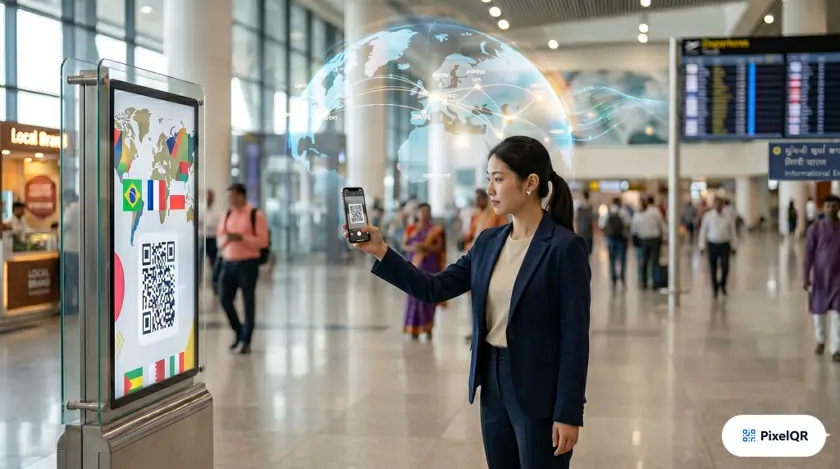
Multi-language QR codes let brands connect with global audiences through intelligent language detection, precise geo-targeting, and cultural optimization. When content appears in a user's native language, engagement rises dramatically—and 72.4% of consumers are more likely to buy products with information in their own language.
Global QR Campaign Impact
In today's interconnected world, businesses can no longer afford to limit their reach to a single language or region. Multi-language QR codes have emerged as a powerful tool for brands looking to maintain personalized, culturally relevant experiences at scale.
Higher engagement in native language
Global QR scans by 2027
Prefer native-language purchasing
ROI with localized campaigns
Understanding Multi-Language QR Codes
Multi-language QR codes are dynamic QR codes that automatically detect the user's language preference and serve content accordingly. Unlike static codes that direct everyone to the same destination, these intelligent codes create personalized experiences based on:
- Device language settings — Automatically detect the language configured on the user's smartphone
- Geographic location — Use IP-based geolocation to serve region-appropriate content
- Browser preferences — Respect Accept-Language headers from the user's browser
- User selection — Allow users to manually choose their preferred language
Language Detection Methods
1. Accept-Language header detection
The most reliable method for web-based language detection. When a user scans a QR code, their browser sends an Accept-Language header indicating preferred languages in order of priority.
Example: Accept-Language: es-MX,es;q=0.9,en-US;q=0.8,en;q=0.7 — the user prefers
Mexican Spanish, then general Spanish, then US English.
2. IP-based geolocation
Determine the user's country based on their IP address and serve content in the primary language of that region. Particularly useful for countries with a dominant language.
3. Hybrid approach (recommended)
Combine multiple detection methods for the highest accuracy. Use a fallback chain that prioritizes user preferences while ensuring every visitor gets appropriate content.
- Check Accept-Language header (most accurate)
- Fall back to IP geolocation
- Use campaign default language
- Display language selector for user choice
Geo-Targeting Strategies
Geo-targeting goes beyond simple language translation—it's about delivering location-specific content that resonates with local audiences. Effective geo-targeting can increase conversion rates by up to 200% compared to generic campaigns.
Regional landing pages
Direct users to region-specific landing pages with local pricing, shipping information, and regional promotions. Include local currency display, region-specific offers, and local contact information.
Time zone optimization
Schedule content delivery based on local time zones for maximum engagement during peak hours. Account for local business hours and event scheduling in each market.
Market-specific offers
Tailor promotions based on local market conditions, competition, and consumer behavior. Use competitive pricing, local partnerships, and seasonal campaigns relevant to each region.
Local support channels
Connect users with local support teams, phone numbers, and communication channels they know. Include local phone numbers, regional chat apps (WhatsApp, LINE, WeChat), and native language support.
Cultural Optimization Best Practices
Translation alone isn't enough. Cultural optimization (also called transcreation) ensures your message resonates emotionally and culturally with each audience. What works in one culture may fall flat—or even offend—in another.
Color psychology
Colors carry different meanings across cultures. Red signifies luck in China but danger in Western markets.
Date and number formats
Use local date formats (DD/MM/YYYY vs MM/DD/YYYY) and number separators (1,000 vs 1.000).
Imagery selection
Use culturally appropriate images featuring local people, landmarks, and relevant scenarios.
Cultural localization checklist
- Review idioms and colloquialisms—direct translation often fails
- Adapt humor carefully—what's funny in one culture may not translate
- Consider text expansion (German text is roughly 30% longer than English)
- Respect local holidays and avoid culturally sensitive dates
- Use native speakers for final review, not just translators
- Localize CTAs—"Buy Now" may work in the US, but softer approaches perform better elsewhere
- Always include an easy-to-find language selector for user control
Implementation Guide
- Create a dynamic QR code — Generate a dynamic code that can redirect to different URLs based on language and location. Enable redirect rules, analytics, and geo-routing. Unlike static codes, dynamic QR codes can be updated without reprinting.
- Set up language-specific destinations — Create localized landing pages for each target language and map them to your QR code's routing rules.
- Configure detection rules — Set up language detection logic with appropriate fallbacks: Accept-Language header first, then IP geolocation, then campaign default, then language selector.
- Test across regions — Before launching, test from different regions using VPNs or testing services. Verify language detection accuracy, fallback behavior, redirect speed, and multi-device compatibility. Watch for regional variants (es-MX vs es-ES).
- Monitor and optimize — Track scan rate, conversion, geo distribution, and engagement by language and region. Continuously optimize based on data.
Language destination mapping example
| Language | Destination URL | Priority |
|---|---|---|
| English (en) | yoursite.com/en/campaign | Default |
| Spanish (es) | yoursite.com/es/campana | 1 |
| French (fr) | yoursite.com/fr/campagne | 2 |
| German (de) | yoursite.com/de/kampagne | 3 |
Global Campaign Success Stories
E-commerce brand
A global fashion retailer implemented multi-language QR codes on product tags. Customers scanning codes were automatically directed to product pages in their native language with local pricing. Results: +156% engagement, +89% conversion, across 12 languages.
Tourism board
A national tourism authority used geo-targeted QR codes at airports and hotels. Visitors received information in their language with culturally relevant recommendations. Results: +234% app downloads, 96% satisfaction, across 8 languages.
Expert Localization Tips
- Prioritize your top 3–5 markets based on traffic and revenue potential—quality over quantity
- Work with native speakers who understand local market nuances; machine translation alone is insufficient for marketing
- Design mobile-first—95% of QR scans happen on mobile devices
- Use regional CDNs to ensure fast loading; a 1-second delay can reduce conversions by 7%
- Adapt call-to-action buttons culturally, not just linguistically
- Always provide a visible language switcher—automatic detection isn't perfect
Frequently Asked Questions
Can one QR code serve multiple languages?
Yes. Dynamic QR codes route through a redirect server that detects language or location and sends users to the appropriate localized page—all from a single printed code.
How accurate is automatic language detection?
Accept-Language headers are highly accurate for web-based scans. A hybrid approach combining browser language, IP geolocation, and a manual language selector covers edge cases like travelers and multilingual users.
Do I need separate QR codes for each country?
No. One dynamic QR code can handle dozens of languages and regions. This is a major advantage for global packaging, trade show materials, and multi-market print campaigns.
How do I handle regional language variants?
Map specific locale codes (es-MX, es-ES, pt-BR, pt-PT) to dedicated pages. Fall back to the base language (es, pt) when a regional variant isn't available.
Can I track performance by language and region?
Yes. PixelQR analytics show scan counts, geographic breakdown, and device data—letting you compare engagement across languages and optimize underperforming locales.
Go Global with Multi-Language QR Codes
Create intelligent QR codes that automatically detect language and location. Reach global audiences with personalized experiences that drive engagement.